
Egypt’s Western Desert is not just a vast expanse of sand, as some may think. Rather, it is an entire world of natural beauty, historical secrets, and tourist treasures that attract adventure lovers and those seeking a unique experience. This desert spans approximately two-thirds of Egypt’s territory, covering more than 680,000 square kilometers, making it the largest natural region in the country. Its borders stretch from the Nile Valley in the east to the Libyan border in the west, and from the Mediterranean Sea in the north to the border with Sudan in the south, creating a unique geographical landscape that combines mountains, oases, sand dunes, and vast plains.
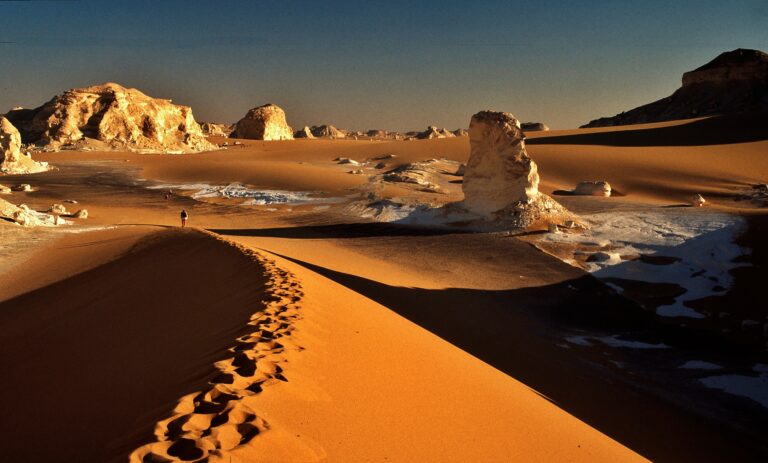
Those who enter the Western Desert feel as if they have stepped out of modern times and into another world of tranquility and peace. During the day, the sun’s rays reflect off the golden sands, illuminating the horizon in shades of yellow and orange. At night, the sky transforms into a celestial theater adorned with stars that shine in a way that is inconceivable in crowded cities. This contrast between the harshness of nature and the softness of the landscape makes the Western Desert an exceptional destination for anyone seeking pure beauty, largely untouched by human hands.
Historically, the Western Desert played a significant role in the lives of the ancient Egyptians. It was a trade corridor for salt and gold caravans, and was home to ancient communities that left behind inscriptions and cave paintings that bear witness to civilizations that vanished thousands of years ago. During the Roman, Coptic, and Islamic eras, the oases served as safe stops for travelers and were a home for agriculture and trade. Even today, some of the customs and traditions practiced by the inhabitants of the oases retain ancient roots.
One of the most striking features of the Western Desert is the diversity of oases scattered throughout it like green islands in a sea of sand. The Siwa Oasis, for example, located in the far west of Egypt, is one of the most attractive tourist destinations due to its pristine nature, freshwater springs, sulfur springs, and famous archaeological sites such as the Temple of Amun and the Mountain of the Dead. Siwa represents a unique case of cultural isolation that has allowed its people to preserve their Berber language and distinctive customs, making a visit to it a cultural and spiritual journey par excellence.
The Farafra Oasis is unique for its natural beauty, concentrated in the White Desert, a rare geological region featuring limestone rock formations sculpted by nature over millions of years, taking on surprising shapes resembling mushrooms, animals, and artistic sculptures. This area is a top stop on safari trips, where visitors spend the nights among the white rocks under a starry sky, an unforgettable experience. Farafra is also famous for its springs and the tranquility that surrounds the area, as if time has stopped there.
Dakhla Oasis, on the other hand, represents a blend of history and nature. It is dotted with ancient villages, such as the Islamic Al-Qasr, built of mud bricks, reflecting traditional architecture. It also contains archaeological sites dating back to the Pharaonic and Roman eras, such as the temples of Deir el-Hajar and Dusht. Meanwhile, Kharga Oasis represents the gateway to the Western Desert and houses the New Valley Museum, which chronicles the region’s history throughout the ages, as well as the Bagawat Tombs, one of the oldest Christian cemeteries in the world.
One cannot discuss the Western Desert without mentioning Bahariya Oasis, located closer to the Nile Valley and famous for its English Mountain and hot springs, as well as archaeological discoveries such as the Valley of the Golden Mummies, which has caused a stir in the archaeological world. Small oases, such as Sitra and others, complete the picture, offering visitors a special touch of simplicity and tranquility.
The Western Desert is not only for history and culture seekers; it is also an ideal destination for adventure lovers. Safaris by four-wheel drive vehicle or camel give visitors the opportunity to explore vast sand dunes, hidden valleys, and natural caves. Many tourists visit this area specifically to camp under the clear skies, where they can see galaxies and planets never seen before. The Western Desert is also an ideal location for photography enthusiasts, as the changing colors of the sand and rocks in the sunlight offer stunning, unique scenes.
The climate in the Western Desert is seemingly harsh, with temperatures soaring during the day and dropping significantly at night. However, this contrast offers visitors a unique experience. In winter, the weather is milder, making this the best time to visit. Remarkably, the inhabitants of the oases have managed to adapt over centuries to these harsh conditions, exploiting groundwater springs for agriculture and establishing stunning traditional irrigation systems, some traces of which can still be seen today.
Life in the Western Desert is not only linked to the oases but also to the nomadic Bedouins who roam the desert with their herds. These Bedouins represent an integral part of the region’s identity, with their stories, legends, and hospitality that impress all who meet them. While some may think of the desert as a barren land, it is in fact teeming with life, culture, and human warmth.
Economically, the Western Desert has played an increasing role in modern Egypt, containing important natural resources such as phosphates, iron, manganese, and petroleum. It is also rich in groundwater, a strategic asset for agriculture, especially with national projects aimed at reclaiming vast areas of desert land. However, the tourist aspect remains the most prominent for visitors from around the world, as it combines pristine nature with a rich history.
It is difficult to sum up the Western Desert in words; it is a place that touches the soul before it delights the eye. It is a vast expanse that invites you to discover yourself amidst the silence of the sands, tempts you to delve into the depths of history among the ruins of the oases, and offers the opportunity to experience an adventure unmatched by any other trip. Perhaps this is why those who visit it once will always think of returning; there is a hidden charm that captures the heart and mind.
A visit to the Western Desert is not just a passing tourist trip; it’s an existential experience that takes you away from the hustle and bustle of everyday life to a world of pure nature and serenity. Anyone who stands before the rock formations of the White Desert, bathes in a sulfur spring in Siwa, or wanders among the palm trees in Dakhla realizes that this place is unlike any other. It is a world of diversity and beauty that deserves to be explored in all its details.
In the end, it can be said that the Western Desert represents a true treasure for Egypt and the world. It is not just an expanse of sand; it is an open museum of nature, history, and humanity. It is an unforgettable destination for anyone seeking the meaning of adventure, serenity of spirit, and the majesty of nature. Anyone who takes their first steps in its soft sands will never be the same again, because the desert will leave an indelible mark on them, an experience that will remain etched in their memory forever.