
The Black Desert – A Stunning Landscape Between the Glow of Sand and the Darkness of Mountains In the heart of Egypt’s Western Desert, nestled between the Bahariya and Farafra Oases, lies a piece of the world unlike any other… It is the Black Desert—a land adorned in dark hues, as if awakened from an ancient volcanic dream. As you approach, you feel as though the golden sands have donned a black cloak of mystery, telling the story of a land once ablaze with fire and teeming with life in distant geological eras. ⋯
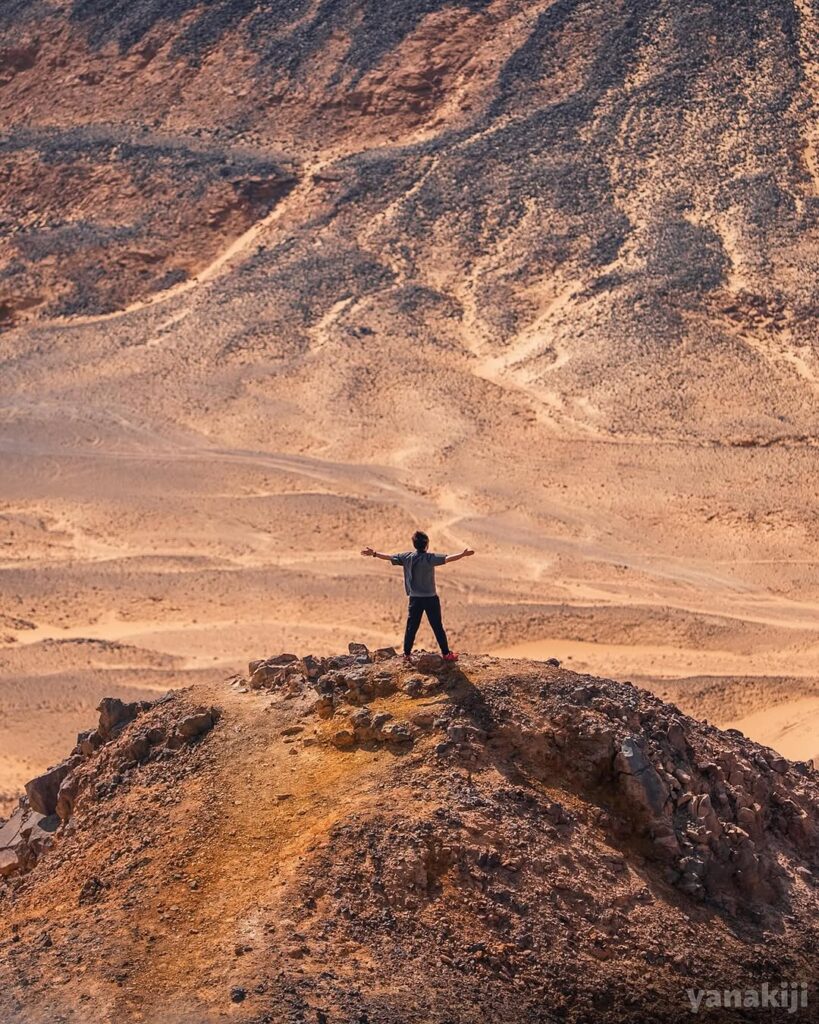
The Beginning of the Geological Tale Millions of years ago, this region was part of an ancient seabed, then witnessed tremendous volcanic activity.
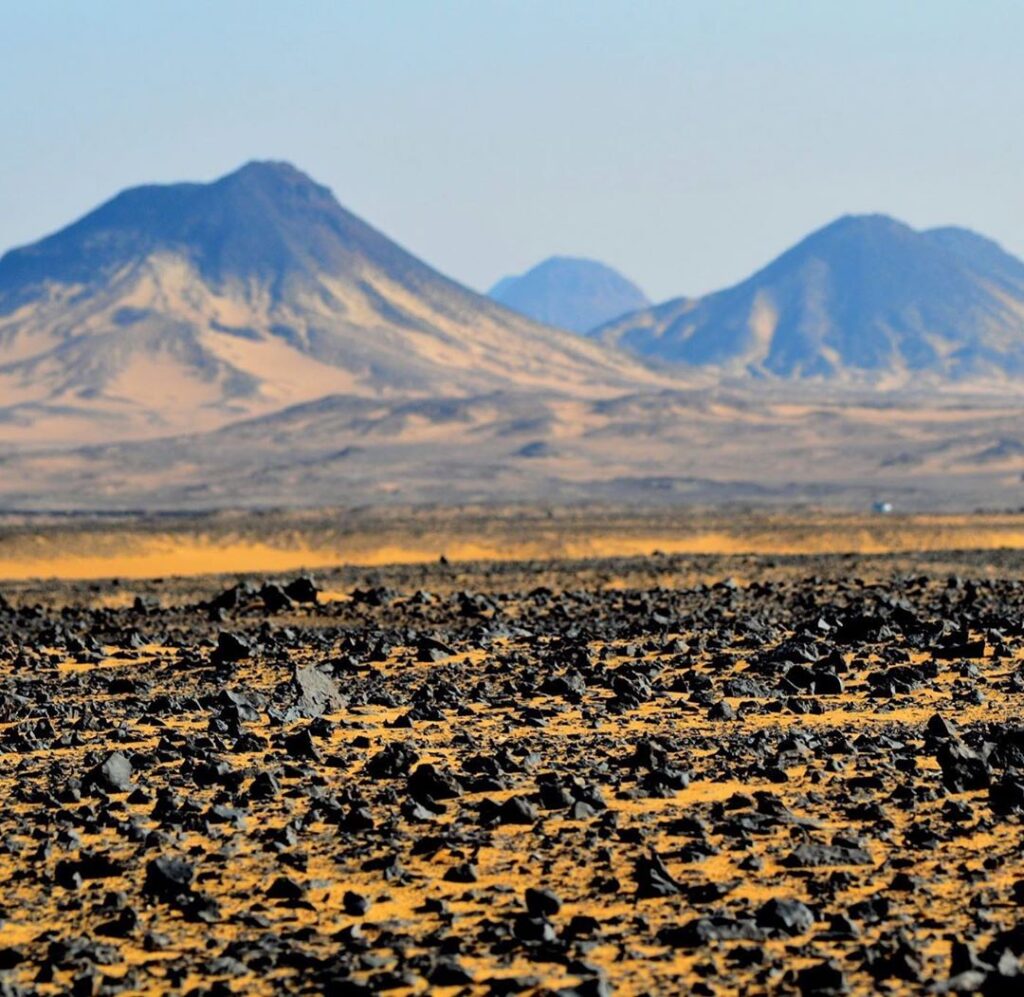
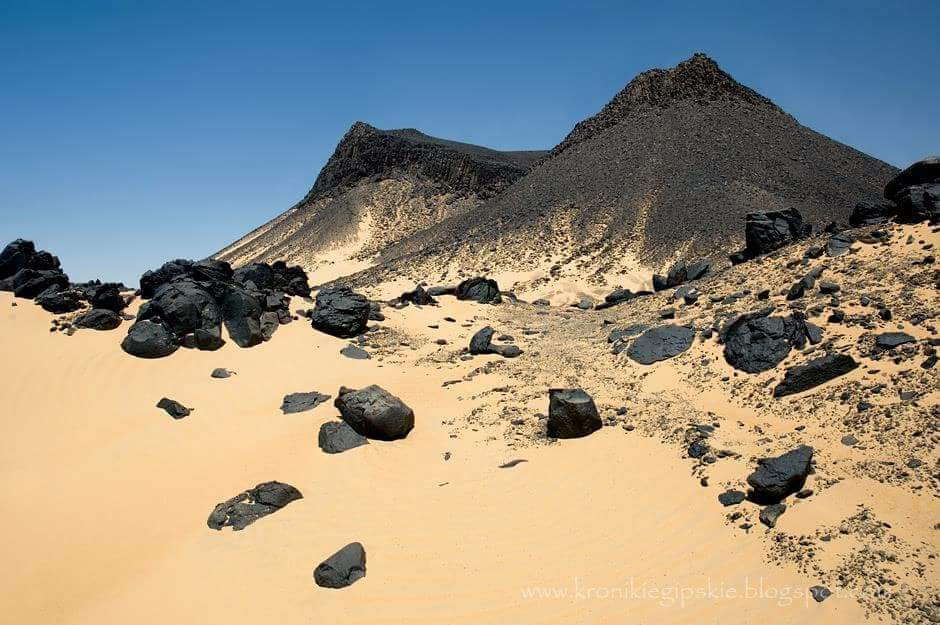
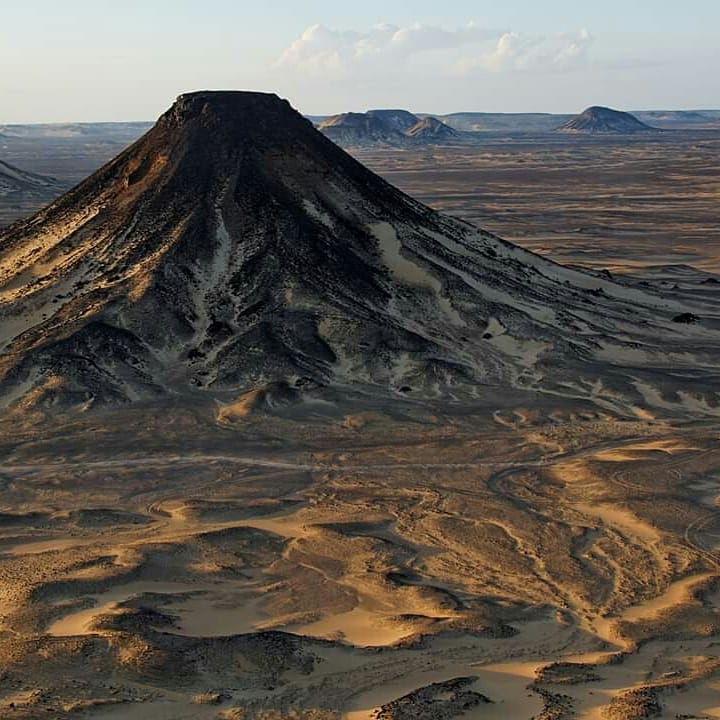
The lava that erupted from the Earth’s interior cooled rapidly, leaving behind black, cone-shaped mountains composed of hard basalt and dark volcanic rock that blanketed the surrounding sandy expanses.
Over the ages, the desert winds began their subtle work, sculpting and reshaping the landscape, until the region transformed into a canvas of gold and black—the light sand against the black volcanic mountains, a sight that captivates at first glance. ⋯
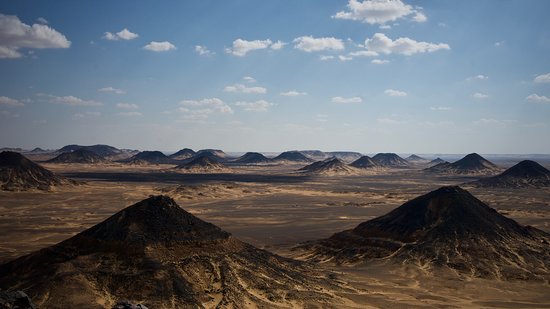
Natural Coal Mountains The most distinctive feature of the Black Desert is the series of small mountains that stretch to the horizon in the form of widely spaced, conical hills.
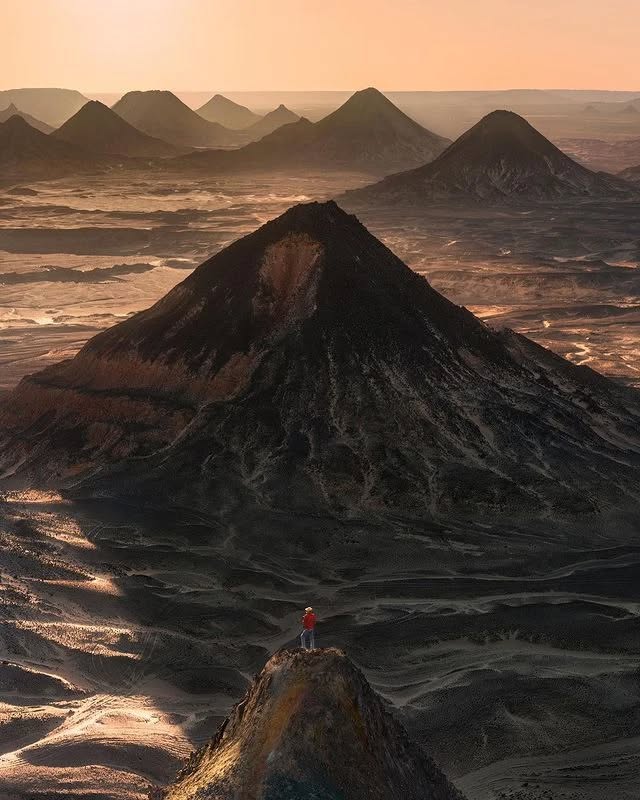
From a distance, they appear as enormous mounds of coal, hence their name.
But they are not actual coal; rather, they are volcanic basalt with a dark, almost black, sheer color.
In the heart of this desert rises a mountain known as English Mountain, the highest peak in the region, reaching a height of approximately one hundred meters.
It was named after a British geologist who used it to study rocks during the colonial era in Egypt, leaving behind some ancient remains that can still be seen today.
A Land That Speaks Through Its Colors As you step onto the black sands of the Sahara Desert, you’ll notice that the golden sands are interspersed with a thin black layer of iron and manganese, the result of the weathering of volcanic rock. Under the sun’s glare, this layer shimmers like tiny star-like particles scattered across the earth’s surface.
Under the sun’s glare, this layer shimmers like tiny star-like particles scattered across the earth’s surface.
At sunset, the scene transforms into a captivating, surreal tableau, as the red sunlight reflects off the black peaks, creating a horizon of smoldering embers—a poetic moment unlike any other.
Between the Black Desert and the Bahariya Oasis The Black Desert lies on the road between the Bahariya and Farafra Oases, about 50 kilometers south of the Bahariya Oasis.
The journey from Cairo takes approximately five hours by car, traversing paved roads followed by open desert tracks.
But the fatigue vanishes the moment you see the view before you… small black mountains scattered like dark stars across the land of gold.
The Bahariya Oasis itself is a key stop for overnight stays and departures on safari trips into the Black Desert. There, visitors can prepare for adventure, whether by riding in a 4×4 or on a camel, before venturing into the world of silence and volcanic beauty. —
A Safari into the World of Blackness Black desert safaris are unforgettable experiences for any lover of nature, tranquility, and adventure. The caravans usually set off early in the morning, after a simple Bedouin breakfast, and then the vehicles head across the sand dunes towards the first volcanic mountains.
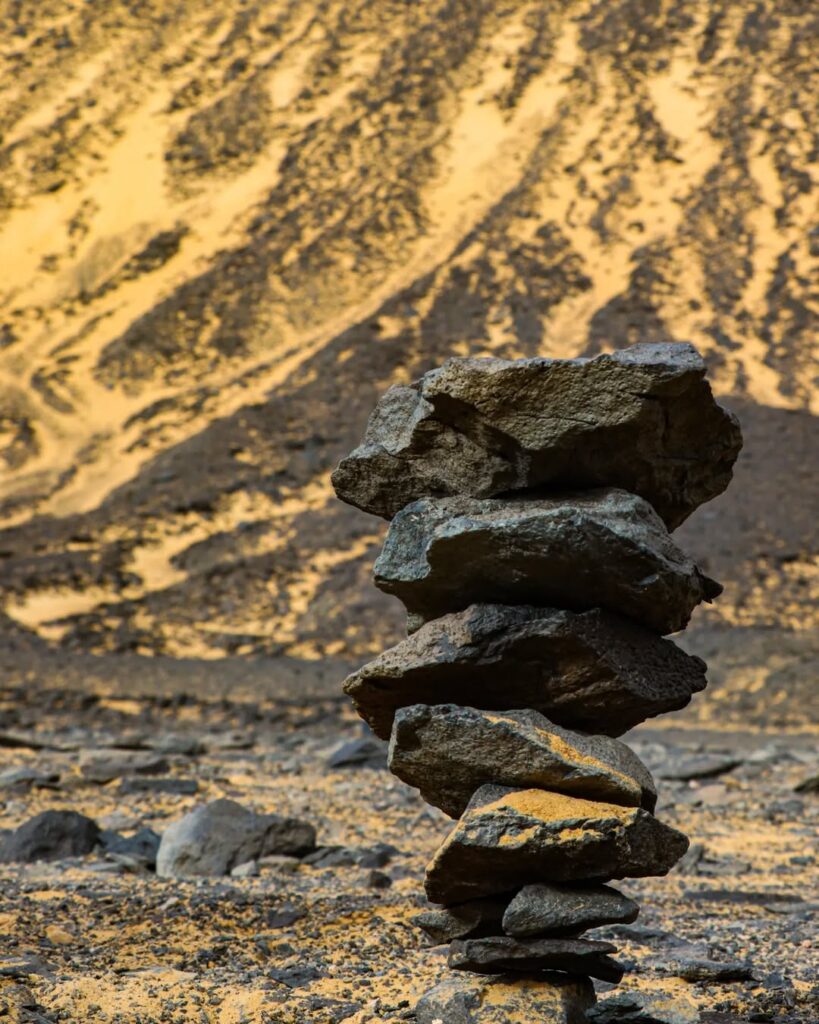
The guide stops at several points to explain the geological formations and how each mountain bears a unique imprint, the result of an ancient eruption or lava flow.
The air there is dry and pure, and the view stretches to the horizon, making you feel like you are on another planet, without noise or boundaries.
Halfway through the journey, the camp is set up in a safe area surrounded by mountains.
A fire is lit to brew Bedouin tea and prepare the traditional meal of rice and grilled meat.
Then, as night falls, the sky begins its enchanting display—thousands of stars twinkling above the ink-black earth, in a scene that is hard to forget.
A Unique Geology Worthy of Study Geologists consider the Sahara Desert a true treasure trove for understanding the volcanic history of North Africa.
Here, layers of rock dating back to the Cretaceous period are visible, when this land was covered in water, then subjected to violent thermal eruptions that transformed its landscape.
Some areas contain sedimentary rocks mixed with basalt, indicating that volcanic activity occurred after the deposition of ancient sand layers.
This phenomenon has made the region a target for study and research, especially in the fields of paleogeology and desert ecology.
Secrets of Ancient Life Despite its arid appearance, the Sahara Desert holds secrets from the distant past.
Fossilized plant remains and small fossils of extinct marine animals have been found on its fringes, confirming that the region was once a fertile marine environment millions of years ago.
Even today, scientists continue to discover new evidence of ancient climate change and the transformations of the land between different geological eras. —
Photography and Ecotourism Adventures The Black Desert is no longer just a geological destination; it has become one of Egypt’s most popular photography spots.
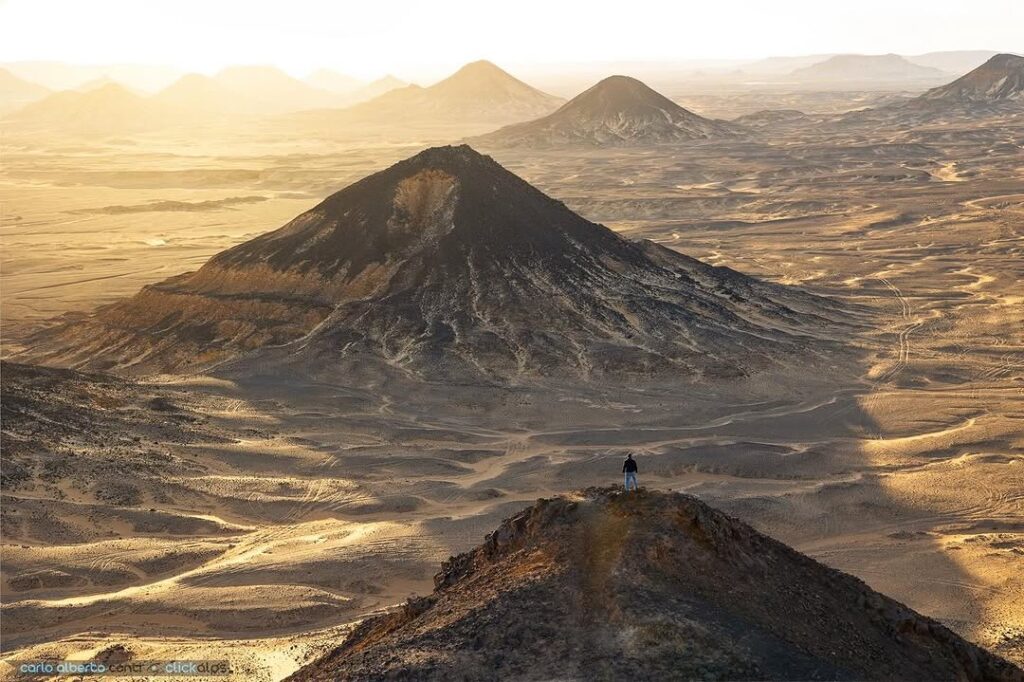
Many photographers come specifically to capture the sunrise and sunset, when the colors transform between gold, gray, and black.
It has also become a haven for ecotourism enthusiasts, who can explore nature without harming it, stay in eco-friendly camps powered by solar energy, and enjoy simple, local cuisine.
Adventurers find it an ideal setting for quad biking and dune bashing, while others prefer long walks to contemplate the enchanting silence that envelops the area.
Between Silence and Beauty
The Black Desert’s most striking feature is its silence.
That profound silence allows you to hear your own heartbeat and feel your presence amidst nothingness.
Here, you hear only the whistling of the wind and the clinking of pebbles as your footsteps touch them.
At night, the silence transforms into celestial music accompanied by the stars, as if you were in a cosmic theater with no audience but yourself and nature.
It is a spiritual experience as much as it is a physical adventure, combining beauty and reverence in the presence of the earth. —
A Bridge to the White Desert
The Black Desert is usually a stop on a journey that extends further towards the White Desert—its radiant neighbor, completing the scene with its white limestone formations.
The transition between the Black and White Deserts is like crossing two contrasting worlds:
From a land of fire to a land of milk, from somber basalt to gleaming limestone.
Many trips last two or three days, starting in the Bahariya Oasis, passing through the Black Desert, then camping in the White Desert, before returning to Cairo. A single journey encapsulates thousands of years of Earth’s history and millions of stories etched by nature in the sands. —
Bedouin Life and the Warmth of Hospitality One cannot speak of the Black Desert without mentioning the Bedouin of the oases, those who have preserved its secrets for generations.
They are the true guides who know its paths, trails, and safe havens.
On safaris, the Bedouin share food and stories around the campfire, recounting tales of hunting, rain, and stars, making you feel like one of them, even if just for a day.
Their simplicity and generosity add a profound human dimension to the desert experience, where there are no boundaries between people and no walls but the horizon. —
In the Embrace of History Although the Black Desert was not as densely populated as the oases, it was an ancient passage for trade caravans.
Travelers in ancient times used it as a shortcut between oases, using the black mountains as landmarks on the horizon.
Some stone carvings and simple artifacts still bear witness to human presence here thousands of years ago. Even in modern times, the region was of interest to nineteenth-century European explorers who described it in their memoirs as “a land of night in the heart of day.”
The Black Desert Today
Today, the Black Desert is one of Egypt’s most prominent desert tourism destinations, attracting thousands of adventurers annually through organized programs.
Egyptian authorities are working to protect the area from illegal activities and preserve its unique natural environment, especially after some companies began offering sustainable ecotourism programs.
Because the place remains untouched, it offers every visitor a rare opportunity to experience the earth’s original nature—as it was before cities, before noise, before human intervention shaped it. —
The End That Never Ends When you leave the Black Desert, you don’t truly leave it… Something of it remains in your memory—the scent of the rocks, the taste of the dust, the silence of the wind, and the blackness of the mountains, like an endless night.
It is not just a desert, but petrified memories from the heart of the earth, reminding you that beauty can be found in simplicity, and that mystery can be nature’s most beautiful color. —
The Black Desert is not just a stop on a journey, but a profound spiritual experience that redefines the meaning of beauty and wonder. Here, between the golden sands and the blackness of the mountains, the earth meets time… and man begins a silent dialogue with history.